Divorce in Canada
In order to file for divorce in Canada you or your spouse must be residing ("ordinarily resident") in the province where you file at the time of filing and for the 12 months immediately before filing. If one of you can meet that minimum residency requirement either of you can literally go down to the nearest divorce court office and file for a divorce today. That is, assuming you can fill out and assemble all the necessary paperwork that fast.
Note:
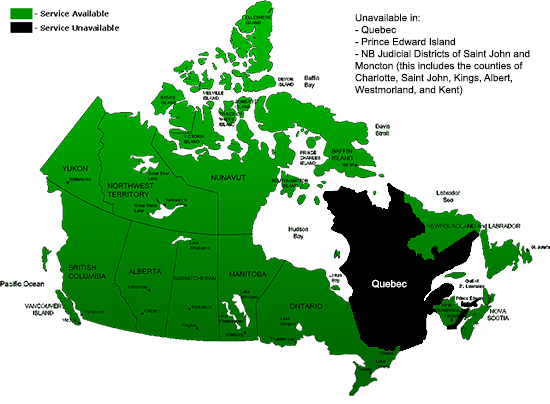
Divorce procedure in the province of Quebec is not addressed here. Some of this information applies in Quebec and some does not.
But before we start talking about the paperwork involved, remember that we said that meeting the residency requirement is all you need to be allowed to "file" for a divorce - but other conditions must be met before your divorce will be granted. Unless and until these conditions are met your divorce documents will just sit in the court file and your divorce will not be granted.
What are these conditions? One of these three things is needed:
- A spouse committed adultery and the other did not forgive him or her.
- A spouse has been cruel to the other (physically or mentally) and the other did not forgive him or her.
- The spouses have been living separate and apart for at least 12 months.
Divorces based on adultery of cruelty are nearly always contested, messy, and time-consuming proceedings. That is why almost all divorces, even when there has been cruelty or adultery, are based on the 12 months of separation.
Tip:
You can read about these things for yourself in the
Divorce Act.
It is important to note that you can still be residing under the same roof and be considered living separate and apart as long as you have truly stopped acting as a married couple - you no longer do things together like eating or sleeping or going out in public together, you have at least started to separate your finances and property, etc.
Let's look at some examples of how some of the things we have talked about work:
| You have been living in Ontario for over a year and you have been separated for over a year. |
 |
You can file right away and your divorce should be finalized within 3-4 months. |
| You have been living in Ontario for over a year but you separated less than a year ago. |
 |
You can file right away but your divorce will not be fully processed until the year of separation has expired. But filing early will speed things up when the year does expire. |
| You just moved to Alberta less than a year ago but your spouse has been living in Ontario for more than a year |
 |
Either of you (or both jointly) can file in Ontario but neither of you can file in Alberta. |
| You moved to BC over a year ago and your spouse has been living in Nova Scotia for over a year. |
 |
Either of you can file in BC or either or you can file in NS, or you can file jointly in either BC or NS. |
Note:
Where you were married does not matter. Your citizenship does not matter. The only requirement is that you or your spouse live in a Canadian province at the time of filing and for the past 12 months.
Even though divorce throughout Canada is governed by the federal Divorce Act, the way it is administered is determined by each individual province and territory. Therefore, the documents and procedures are very different depending on the jurisdiction in which you file for divorce. Visit the following pages for detailed information about divorce procedure in the various provinces:

If you have not yet done so, take a moment now to discover how using our divorce document assembly service can save you both time and money. Follow this link for more information about divorce in Canada generally, or about specific other provinces.